
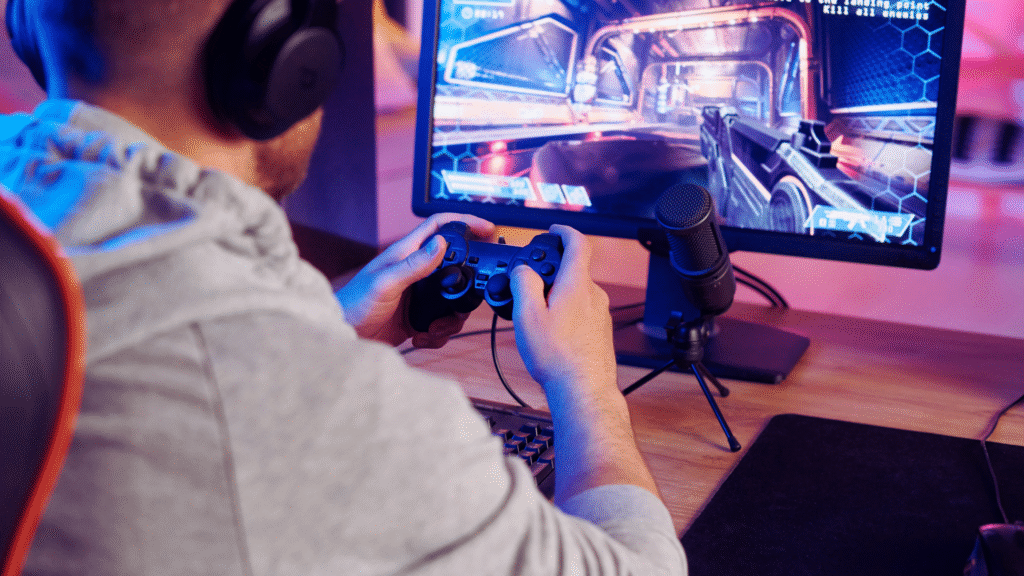
Online shooters can be intimidating for new players due to fast-paced action and skilled opponents. Understanding game mechanics, map layouts, and aiming fundamentals is essential to improving quickly. What every new player should know is that mastering basic controls and staying calm under pressure creates a strong foundation for progress.
Communication and teamwork also play a critical role in most online shooters. Players who learn to coordinate with teammates and adapt strategies have a noticeable edge. Online shooters reward practice and patience more than quick reflexes alone, which gives newcomers a clear path to improvement.
Fundamentals of Online Shooters
Online shooters come in various formats and styles, each with distinct gameplay mechanics and player expectations. Understanding the core differences in game types, perspectives, and popular franchises helps new players navigate the genre more effectively.
Understanding Shooter Game Types
Shooter games mainly divide into tactical shooters, battle royale, and arena shooters. Tactical shooters like Rainbow Six Siege focus on strategy, teamwork, and realistic mechanics. Players often control “operators” with unique gadgets, emphasizing planning and slow-paced action.
Battle royale games such as Apex Legends and Fortnite involve large player counts, a shrinking play area, and scavenging for weapons and gear. The goal is to outlast others in a dynamic environment. Fast reflexes and map knowledge are key skills here.
Arena-style shooters like DOOM Eternal and Valorant blend fast-paced combat with character-specific abilities. These games often emphasize individual skill, precise aiming, and quick movement. Many are free-to-play and have active esports scenes.
First-Person vs Third-Person Perspectives
First-person shooters (FPS) show gameplay through the player’s eyes, creating immersion and focusing on precise aiming. Popular FPS games include Call of Duty, Counter-Strike, and Halo Infinite. This view enhances accuracy but limits situational awareness to what is directly in front.
Third-person shooters display the character from behind or above, like The Finals or Escape from Tarkov. This perspective allows players to see their surroundings and character model, aiding in tactical movement and situational awareness at the cost of reduced aiming precision.
Some shooters mix perspectives, with players switching between them depending on specific gameplay moments. Understanding these perspectives helps players choose the right type of shooter to match their style.
Overview of Popular Shooter Franchises
Call of Duty remains one of the most well-known FPS series, with extensive multiplayer modes and battle royale in Black Ops 6. Counter-Strike and Valorant, both known for esports, prioritize teamwork and precision in smaller match settings.
Apex Legends and Fortnite lead in the battle royale space, featuring diverse characters and fast-paced, dynamic combat. Rainbow Six Siege emphasizes strategic play with its unique “operators.” Battlefield is known for large maps, vehicle combat, and combined arms warfare.
Other notable titles like Destiny 2 and Halo Infinite offer sci-fi settings with varied multiplayer modes. Hunt: Showdown and The Finals introduce survival and innovative mechanics, expanding what players expect from shooters today.
Essential Skills for New Shooter Players
Mastering key skills such as movement, aiming, and map awareness lays the foundation for effective gameplay. Players who focus on specific techniques improve their survival and success in competitive online shooter environments.
Movement and Positioning
Effective movement controls how easily a player avoids enemy fire and secures advantageous spots. Learning to strafe around corners, crouch for stability, and use cover intelligently reduces exposure to damage.
Positioning involves choosing locations that offer visibility and protection. Holding high ground or tight angles gives players a tactical edge. Movement should support positioning, ensuring the player isn’t caught in open or predictable areas.
In team-based shooters, coordinating positions and rotations with teammates helps in controlling objectives and managing map control. Practicing smooth, unpredictable movement patterns also prevents enemies from landing shots easily.
Crosshair Placement and Aiming
Consistent crosshair placement minimizes the need for large corrections during engagements. Players should keep the crosshair at head level and aimed at common enemy locations.
Aiming requires controlled mouse movement and quick reaction time. Training with aim practice tools or in-game bots enhances precision. Likewise, anticipating enemy movement improves hit registration.
Players benefit from focusing on small, precise adjustments rather than sweeping motions. This skill directly impacts gunplay effectiveness, especially in faster-paced competitive gameplay.
Weapon Control and Recoil Management
Different guns have unique recoil patterns that players must learn and counteract. Recoil control involves moving the mouse in the opposite direction of the gun’s kickback to maintain accuracy.
Burst firing and tap shooting help conserve ammo and reduce bullet spread, important for long-range engagements. Full-auto firing demands skillful control to avoid spray that drastically lowers hit chances.
Players should experiment with weapon attachments and consider grenade usage to complement gunplay. Combining firing techniques with tactical grenade deployment increases combat options and map control.
Game Sense and Map Awareness
Recognizing enemy positions, common routes, and objectives is critical to survival and tactical planning. Good map awareness allows anticipation of threats before they appear.
Sound cues like footsteps and grenade explosions inform decision-making. Players should actively listen and frequently check the minimap to track enemy movements.
Understanding timing in competitive gameplay—when to push or fall back—comes through experience. Developing game sense improves reaction to dynamic scenarios and supports smarter, more deliberate plays.
Mastering Shooter Game Mechanics
Success in online shooters depends on understanding how to manage resources, adapt to dynamic environments, and leverage unique character abilities. Each factor shapes a player’s strategy and decision-making during matches.
Economy and Loadout Management
Resource management is crucial in shooters, especially in modes like battle royale or esports, where purchasing power affects gameplay. Players must decide when to save or spend in-game currency to buy weapons, armor, and equipment.
Smart players prioritize essential gear while balancing risk and reward. For example, saving currency early can allow for better weapons later. Loadouts should complement individual roles—snipers need long-range rifles, while aggressive players benefit from close-combat weapons.
Understanding the economic cycle—knowing when opponents likely have strong gear—helps players time their engagements. Efficient loadout choices increase survival chances and combat effectiveness throughout matches.
Destructible Environments and Utilization
Destructible environments change battlefield dynamics and create tactical options. Players use cover that can be destroyed, forcing constant relocation and map awareness.
Knowing which objects are destructible allows players to break enemy cover or create new sightlines. This mechanic rewards adaptable gameplay rather than static defense.
In games with destructible terrain, competitors can disrupt fortifications or block choke points. Mastery of this element enhances strategic positioning and surprise maneuvers, a key factor in competitive and esports play.
Using Operators and Abilities
Operators or characters with unique abilities add depth to shooters. Each operator usually has specific skills like healing, reconnaissance, or controlled destruction.
Players must learn how to maximize these abilities in coordination with teammates. For example, a recon operator can reveal enemy locations while a defensive one sets traps or barriers.
Operator selection affects team composition and tactics. Using abilities effectively often turns the tide in tight matches, especially in esports settings where teamwork and role synergy are critical.
Progression, Community, and Esports
New players should expect to improve steadily by practicing regularly, engaging with different competitive modes for skill testing, and exploring opportunities in esports or streaming to deepen their involvement.
Improving Through Practice
Consistent practice is essential for mastering game mechanics like aiming, movement, and map awareness. Players should focus on specific skills in short, focused sessions rather than long, unfocused playtimes.
Using training modes or aim trainers can speed up improvement. Reviewing gameplay clips helps identify mistakes and better understand positioning and decision-making.
Regularly playing with teammates or joining squads improves communication and teamwork, which are critical in most online shooters.
Understanding Ranked and Competitive Modes
Ranked modes pit players against others of similar skill to provide balanced, challenging matches. They use a matchmaking rating (MMR) system that rises or falls based on performance.
Competitive modes often have stricter rules, fostering strategic depth and consistency. Players should learn game-specific tactics like economy management and timing for better outcomes.
Ranked seasons typically reset periodically, offering fresh goals and rewards such as skins or titles. Maintaining consistent performance prevents rank drops and builds long-term skill.
Exploring Esports and Streaming Opportunities
Esports tournaments offer a platform for the highest level of competition, often with prize pools and team sponsorships. Players interested in esports should build skills competitively and participate in qualifiers or local competitions first.
Streaming provides a way to share gameplay, build a community, and potentially earn income. Consistent content creation, viewer interaction, and unique personality traits drive growth.
Both esports and streaming require time, dedication, and a solid understanding of the game’s meta and community trends to succeed.